
Finding Chalmette Residents
Choose the first record by the fact already known. A street address points to the free St. Bernard Parish Assessor search and its parcel card. A person's name can be checked through the Louisiana Voter Portal, Clerk of Court eSearch, historical vital indexes, or statewide license and business records. For a household from an earlier decade, Nunez Community College Archives, Louisiana State Museum catalog records, newspapers, and church collections are more useful than a current portal. The sources overlap, but none is a master household list.
Official records describe legal relationships. An assessor card identifies owners and mailing contacts, not all occupants. A voter result concerns a registered voter, while a deed identifies parties to a recorded instrument. Renters, children, people who do not register to vote, and anyone with protected address status may leave little or no public trail. Confirm a possible match with two independent fields before treating it as the same person.
- Search the Assessor by owner name, property address, parcel, subdivision, legal description, or section, township, and range.
- Use the Louisiana Voter Portal's person or address route without assuming it lists every resident.
- Carry a parcel's deed number, book, and page to the Clerk's paid eSearch or courthouse counter.
- For older households, ask Nunez Archives and state repositories for directories, clippings, and finding aids.
- Request a precise parish-held record through the public-record form when no department database exists.
Chalmette Records Office Guide
Chalmette is the St. Bernard Parish seat and a census-designated place, not an incorporated city with a separate municipal clerk. That local quirk changes where a resident search begins. The Clerk of Court is the ex officio recorder and keeps land and court filings. The Assessor maintains the current parcel roll. The Registrar of Voters handles registration and district information. Parish Government keeps planning, GIS, ordinances, contracts, and departmental files. These offices occupy different buildings, so check the custodian before visiting. The Chalmette street directory explains the address chain in depth.
St. Bernard Parish Clerk of Court
1101 W St. Bernard Highway
Chalmette, LA 70043
504-271-3434
St. Bernard Parish Assessor
2118 Jackson Boulevard, Suite A
Chalmette, LA 70043
504-279-6379
St. Bernard Registrar of Voters
8201 W Judge Perez Drive
Chalmette, LA 70043
504-278-4232
Free Chalmette Parcel Clues
The St. Bernard Parish Assessor Property Search is the strongest free first stop for an address or owner. Its six modes cover parcel number, owner name, property address, section-township-range, subdivision, and partial legal description. Results show parcel number, name, physical address, and a details link. A detail card can add mailing address, ward, property type, legal description, valuations, exemption flags, subdivision, block, lot, deed rows, ownership history, and tax districts. Search only a last name at first when spelling is uncertain.
The portal was configured for tax year 2026 when researched, with no prior-year selector. That limit matters. Historical deed and ownership rows may appear on a current card, but the portal does not promise a complete run of old assessment rolls. Tax values are tax valuations, not current sale appraisals. A mailing address can also differ from the physical or situs address, especially for a public body, estate, or nonresident owner.
| Search route | Best starting detail | Useful result |
|---|---|---|
| Owner name | Surname, then fuller name | Possible parcels and mailing ties |
| Property address | Number and street | Physical parcel match |
| Parcel number | Exact assessor identifier | Direct details card |
| Subdivision | Recorded subdivision name | Properties within that plat area |
| Legal description | A distinctive partial term | Matches beyond postal wording |
From Parcel to Chalmette Deed
An assessor card can save the cost and guesswork of a broad recorder search. Copy the deed number, type, date, book, and page, then use those fields with the St. Bernard Parish Clerk. The Clerk's eSearch requires a user ID, password, and paid subscription for indexed land, civil, or criminal records. Visible prices include $20 daily access for one category, $40 monthly for one category, and combined monthly plans from $50 to $70. Images and minutes generally display a $1 price in the portal. Check its Certified Dates before assuming the online index covers the needed period.
A parish archive cover sheet illustrates the fields available in a recorded index. The 2011 adjudication example lists file 553991, Book 1021, Page 532, recording date, document ID, vendor, vendee, document type, and page count. Those fields identify an instrument, but a cover sheet alone does not prove present ownership or a complete title chain. Obtain the underlying image and compare it with the current assessor card. If eSearch is unsuitable, call 504-271-3434 or visit the Clerk at 1101 W St. Bernard Highway and ask about the current copy and certification procedure.
The manifest capture of the St. Bernard Clerk login shows the subscription gate a researcher meets before indexed records.
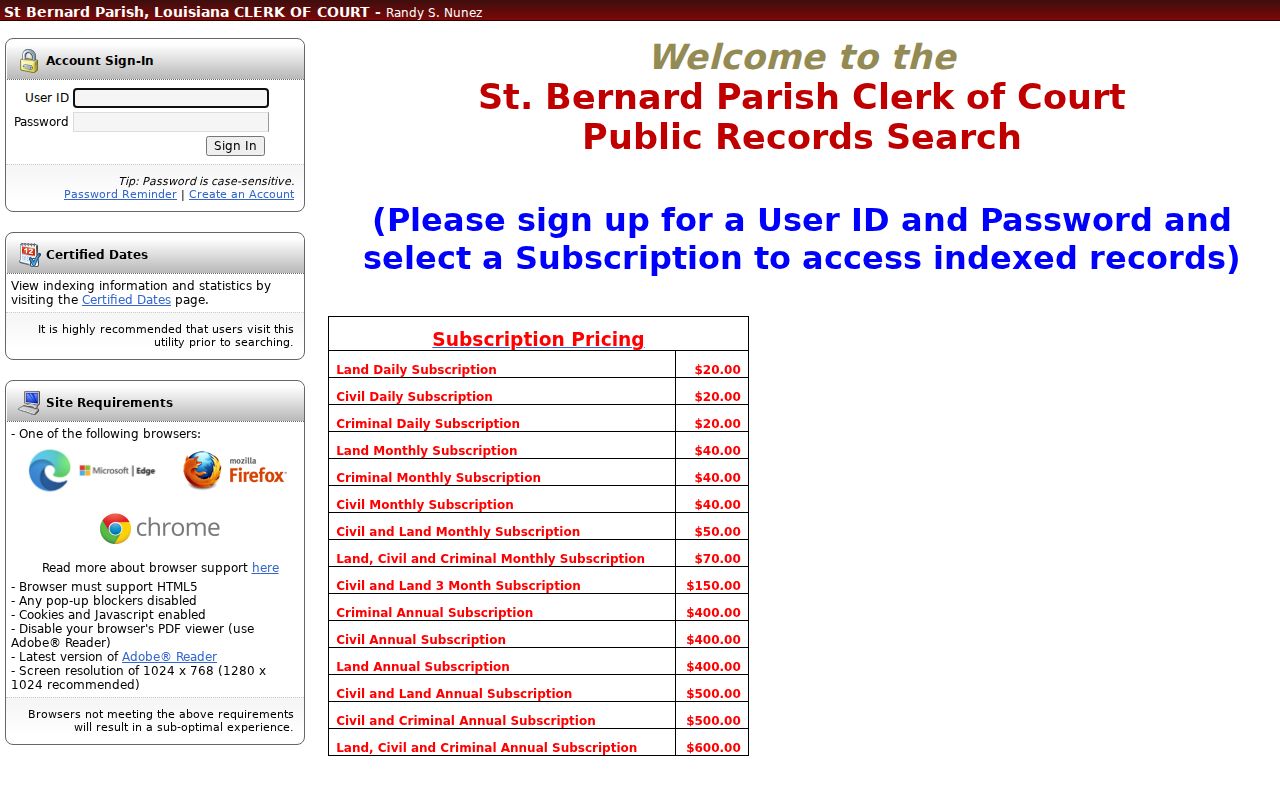
Seeing the gate before paying helps set expectations: the public URL is not a free, open name-search form.
Chalmette Voter Lookup Routes
The Louisiana Voter Portal separates a voter search from an address search. A person search asks for identifying details and returns an individual registration view when the supplied values match. The address route is useful for election geography, including precinct and district context, but it should not be treated as a complete roll of every adult at a home. The full voter file is governed by Louisiana law and request rules, and certain details remain protected.
The local office is the St. Bernard Registrar of Voters at the parish complex. It can explain registration, name or address corrections, status, precincts, and district assignments. Contact the office by phone, email, fax, or in person when the portal does not resolve a match. Louisiana's Address Confidentiality Program and other statutory protections mean a missing public address may be intentional. Never use a dead end as evidence that a person has no local connection.
Current Chalmette Directory Sources
Current directory evidence is scattered among sources created for taxes, elections, recording, courts, and licensing. Each names a limited group and should be labeled by its actual relationship to Chalmette. The Assessor lists property owners. The voter system covers registered voters under state rules. Clerk indexes name parties to filings. The Secretary of State business database names entities, officers, and registered agents, while professional boards may identify licensees. Community groups listed by the parish do not publish verified member directories.
| Official source | Named relationship | Custodian | Route |
|---|---|---|---|
| Assessment roll | Owner and mailing contact | Parish Assessor | Free portal |
| Voter Portal | Registered voter or election address | Secretary of State and Registrar | Official lookup |
| Clerk eSearch | Parties to deeds and cases | Clerk of Court | Paid subscription or counter |
| Commercial Search | Business officers and agents | Louisiana Secretary of State | Free search |
| Civic records | Named boards, petitions, and actions | Parish Government | Archives or request |
Use the source that states the needed relationship, then verify the match elsewhere. The Chalmette resident lookup gives a one-person workflow and explains how to separate two people with the same name.
Chalmette Court and Vital Trails
The 34th Judicial District Court serves St. Bernard Parish, but research did not locate a free, open court-docket name search. The Clerk's subscription eSearch covers civil and criminal index material, while the courthouse remains the direct fallback. Restricted, sealed, expunged, juvenile, and adoption material is not opened merely because someone asks. Federal cases use PACER, and official statewide criminal-history channels have their own identity and eligibility rules.
Vital records split by record type and age. Louisiana Department of Health keeps current birth and death records under eligibility limits. Historical birth records become available after 100 years and death records after 50 years, with the State Archives and Secretary of State indexes supplying an older trail. Marriage records are held by the Clerk, while divorce evidence belongs in the court record. Church registers, newspapers, probate files, and cemetery custodians can bridge a historical gap, though no official parishwide cemetery lookup was found.
Match the record, not just the name. A court party, property owner, business agent, and registered voter are different roles. Confirm a second field such as address, middle name, date, parcel, or case relationship.
Requesting Chalmette Parish Records
Louisiana Public Records Law, including La. R.S. 44:31 through 44:35, supports access to public records while preserving statutory exemptions. St. Bernard Parish provides an online Public Records Request Form with email, pickup, and postal delivery choices. Its notice lists $0.35 per electronic page and $0.70 per black-and-white copy. The form states no fixed processing time.
Write a narrow request. Name the department, record series, date range, address, parcel, docket, or ordinance number. The parish specifically says it does not maintain marriage certificates, divorce certificates, criminal certificates, or police reports. Route those to the Clerk or Sheriff's Criminal Records and Reports unit as appropriate. For incident reports, the Sheriff's published contact is 504-278-7726. Ask for a written exemption citation if access is denied, and never send payment or identity documents until the custodian confirms the current method.
Chalmette GIS and ZIP Context
Parish GIS links an address to parcels, streets, zoning, subdivisions, flood applications, permits, code matters, and planning records. Map layers are leads, not legal proof. The parish warns that parcel information changes with sales and re-subdivisions. Keep the Assessor's physical address and legal description with any map result, then use a plat or recorded instrument for a boundary question.
Chalmette also has overlapping geographic labels. USPS uses 70043 and 70044 for the Chalmette mailing city, while Census ZCTA patterns and neighboring postal areas do not reproduce the CDP or parish boundary. Arabi, Meraux, Violet, and named subdivisions may appear in nearby records. Confirm the exact address through USPS, then compare the Assessor and GIS rather than forcing every St. Bernard result under one city label. The Chalmette ZIP code directory keeps those distinctions clear.
Chalmette Archives Fill Gaps
Nunez Community College Library Archives is the most fully documented local-history stop. Anyone may research there at no charge. The archive is on the second floor of the Library Arts, Sciences & Technology Building, 3710 Paris Road, and offers help in person, by phone, mail, email, or web call. Its roughly 200 linear feet of St. Bernard material and more than 600 oral-history papers, audio recordings, and video tapes reach beyond transactional databases.
The Frank Fernandez Collection has a comprehensive index with more than 50,000 entries. Other groups include Police Jury minutes, press clippings, photographs, maps, historic-house and plantation files, postcards, church-fair materials, Katrina records, krewe files, Los Isleños recordings, and historical society newsletters. A name in an oral history is a lead, not legal identity proof, but it can restore context erased from a modern roll.
The Nunez Archives page is captured in the city-directory image set; the full shelf guide and request strategy appear on the Chalmette city directory page.
Chalmette Courthouse Record Story
St. Bernard's courthouse history explains why an old name may require several custodians. The first courthouse stood on the historic site in 1848. Government later moved to Stocklanding and Arabi, returned in 1880, and the building burned in 1884. The 1914-1915 courthouse was designed as largely fireproof, damaged by the 1915 hurricane, and moved to Chalmette in 1939 after a 1,360-to-5 vote. It later served as a school, was affected by Katrina and Camp Hope, and underwent FEMA-supported restoration from 2010 through 2012.
The exact records lost in the fire were not verified. Do not claim that all early records vanished. Instead, check duplicate indexes, Clerk books and microfilm, Police Jury minutes at Nunez, Louisiana State Archives guides, church registers, and newspapers. Preserve the office and place name printed in the original item because older records may use a community label that differs from today's postal city.
Historical Chalmette Resident Directories
The Louisiana State Museum Historic Center catalog identifies St. Bernard telephone-directory items in record group 514, including a post-2003 run that spans the Katrina era. Catalog descriptions contrast a pre-Katrina volume about three-quarters of an inch thick with a later book about one-quarter inch thick. That physical difference is a research clue, not a count of departed residents. The actual pages must be consulted before drawing conclusions about any household.
The State Library's Louisiana Collection holds city directories and telephone books, newspapers, maps, census and parish records, vertical files, and microfilm, though an exact complete Chalmette run was not verified online. The State Archives, Library of Congress record for the St. Bernard Eagle, FamilySearch church catalogs, Los Isleños material, and Nunez finding aids add different eras. Ask each repository for exact holdings and reproduction rules. A directory entry can establish a name, address, spouse or occupation as printed for that year, but it does not prove uninterrupted residence. Compare adjacent volumes and then move to deeds, census schedules, newspapers, or vital indexes.
Build a citation while the volume is open. Record the repository, collection or record-group number, title, printed year, page, column, and the spelling exactly as shown. Photograph the abbreviation key when copying is allowed. If staff supplies a scan, keep its filename and request correspondence with the entry. Those details make it possible to distinguish an actual directory hit from a later transcription and let another researcher locate the same original page.