
Chalmette Previous Resident Sources
No record spans every era or proves every occupant. For Chalmette previous residents, the free parcel card is the modern starting point, recorded deeds carry ownership backward, and dated publications supply household clues. Archives bridge the years before online systems. The verified coverage below distinguishes a known range from an unresolved cutoff.
| Source | Years It Covers | Where Held | What It Shows |
|---|---|---|---|
| Assessor parcel card | Current 2026 roll; sample deed rows to 2006 | St. Bernard Assessor | Current owner, situs, legal description, deed and ownership rows |
| Clerk conveyances | Online cutoff not displayed | Clerk eSearch or courthouse | Grantors, grantees, dates, book/page, recorded image |
| RG 514 telephone books | 2003-2004 through 2007-2008 labels | Louisiana State Museum | Names and addresses in the requested volumes |
| Police Jury minutes | 1880-1929 | Nunez Archives | Roads, petitions, projects, names, public improvements |
| Historical birth index | 1819-1925 service; early gaps | Louisiana State Archives | Child, parent, place, and date clues |
| Death catalog | 1900-1965 | FamilySearch / State Archives material | Death record leads under St. Bernard parish code 44 |
For a recent address, begin with the parcel and deed rows. For a pre-Katrina household, request the matching telephone book. Earlier work may require census, minutes, newspapers, church records, and archives. A directory date is a publication snapshot, not an exact move-in date.
Start Chalmette Address History Today
The St. Bernard Assessor lets a researcher search by Property Address without an account. Enter the number and current street name, open the detail card, and save the parcel number, physical address, owner, mailing address, legal description, subdivision or tract, deed rows, and ownership-history ranges.
Mailing and physical addresses serve different jobs. A mailing address may point to an agent, government office, or out-of-parish owner. The physical, or situs, address locates the parcel. Homestead data may suggest owner occupancy, but it does not identify every person in the home. The live portal has no prior tax-year selector, even though deed and ownership rows on a card can reach back farther.
Best first move. Copy each deed book/page and the legal description from the free card before opening the subscription Clerk system.
Trace Chalmette Owners Backward
The St. Bernard Parish Clerk of Court is the ex officio recorder. Its eSearch portal requires an account and subscription for indexed land records. Do not assume the login page offers a free name search. Daily land access is listed at $20, monthly land at $40, and displayed land images at $1 each. The exact index start and imaging cutoff were not visible before login.
- Pull the present owner, parcel, legal description, and deed references from the Assessor card.
- Retrieve the current owner's purchase instrument by book/page or another recorded identifier.
- Read the seller, or grantor. Search that person as an earlier buyer, or grantee, using the same land description.
- Repeat backward and log each recording date, instrument type, party, book/page, and prior-reference clause.
- When the online index stops, call the Clerk at 504-271-3434 or visit 1101 W St Bernard Highway for the older book or image route.
- Grantor / grantee
- The grantor transfers an interest; the grantee receives it.
- Chain of title
- The linked series of recorded transfers for the same land.
- Legal description
- Lot, block, subdivision, tract, or boundary wording that identifies land even when its street label changes.
A title chain proves recorded interests, not everyone who lived there. Donations, successions, rights of way, and adjudications may appear beside sales. Read the whole instrument and carry the legal description across each link.
A Chalmette Deed Index Story
An official 2011 St. Bernard archive cover sheet shows what a recorded pointer can reveal before the whole image is read: Conveyance index, Adjudication document type, file number, book/page, recording date, document ID, vendor, and vendee. It also shows the limit. A cover sheet alone does not establish current ownership, possession, or a complete chain.
The practical lesson is to pair index metadata with the underlying recorded image and today's parcel card. A record marked incomplete or not verified in eSearch may still be moving through indexing and release. Status is not proof that the filing is invalid.
Katrina Split in Chalmette Directories
The Louisiana State Museum's RG 514 catalog lists St. Bernard telephone directories for 2003-2004, 2005-2006, 2006-2007, and 2007-2008. The catalog says three books are pre/post Katrina even though four date labels appear, so request the item IDs rather than guessing which volume the description means.
Its most striking measured clue is physical: the pre-Katrina volume was about three-quarters of an inch thick, while a later book was about one-quarter inch. That comparison reflects major loss of people, services, and firms, but it does not identify a specific household. Only the actual pages can show previous residents at an address.
Search the exact number and street spelling in adjacent volumes. If the entry vanishes, test a changed label and then check the parcel, rebuilding files, newspaper notices, or oral histories. A missing line may mean a move, omission, publication lag, or service interruption.
Nunez Finds Chalmette House Clues
The Nunez Community College Library Archives in Chalmette is the strongest local fallback when the digital trail breaks. Its collections include historic-home and plantation files, maps, photographs, clippings, oral histories, Police Jury minutes, publications, and post-Katrina material. The Frank Fernandez index contains more than 50,000 entries, while the archives describe over 600 oral-history papers, recordings, and videos.
Research is open to anyone and free. Staff can help in person, by phone, mail, email, or web call. Send the street-number variants, current parcel and legal description, known owner names, subdivision, and date span. Ask staff to check the Fernandez index, maps, minutes, clippings, historic-home files, and telephone directories. No official fixed-fee house-history service was found, so frame the request as a focused archives search.
Los Isleños oral histories and Spanish-language recordings are especially useful for family and community context. They are leads, not legal proof of residence.
Bridge Old Chalmette Street Labels
Current Assessor data includes punctuation and road-type variants such as BAYOU RD, BAYOU ROAD, and BAYOU RD. Preserve the original form found in each source. Search with and without an abbreviation, retain a directional prefix, and distinguish Judge Perez and St. Bernard Highway forms carefully.
The parish's 2025 archive includes a street-renaming petition at Stay Park Drive in another St. Bernard mailing area. That docket does not establish a Chalmette change. It does confirm that renaming evidence can live in Planning Commission files, ordinances, surveys, GIS layers, Clerk plats, and USPS verification. No complete Chalmette renaming or renumbering list was located.
When names fail, use the legal description. Lot, block, subdivision, section, township, range, tract, and right-of-way language can connect older and newer addresses more safely than a guessed modern spelling.
Note: Save both the source address and the normalized address so later changes do not erase the wording that produced the match.
Why Chalmette Records Are Scattered
St. Bernard's courthouse history explains why previous residents may require more than one repository. The first courthouse stood on the historic site in 1848. Parish government later moved, returned in 1880, and the courthouse burned in 1884. The 1914-1915 building suffered hurricane damage, and government moved to Chalmette in 1939 after a 1938 vote.
The old building later served as a school, was affected by Katrina and Camp Hope, and was restored with FEMA support in 2010-2012. The exact volumes lost in the fire were not identified in the research. Still, the repeated moves and disasters make duplicate indexes, Clerk books, Nunez minutes, State Archives guides, and microfilm important. Do not invent a missing-record claim when a source merely sits with another custodian.
Close Chalmette Resident Trails
A deed trail often ends with a succession, and a household trail may end with a death notice or probate file. Louisiana's historical birth index service reaches 1819-1925, though pre-1918 non-Orleans records have gaps. The FamilySearch death catalog covers Louisiana deaths from 1900-1965 and uses parish code 44 for St. Bernard.
The Louisiana historical birth index can supply a parent, place, and date clue for eligible historical entries.
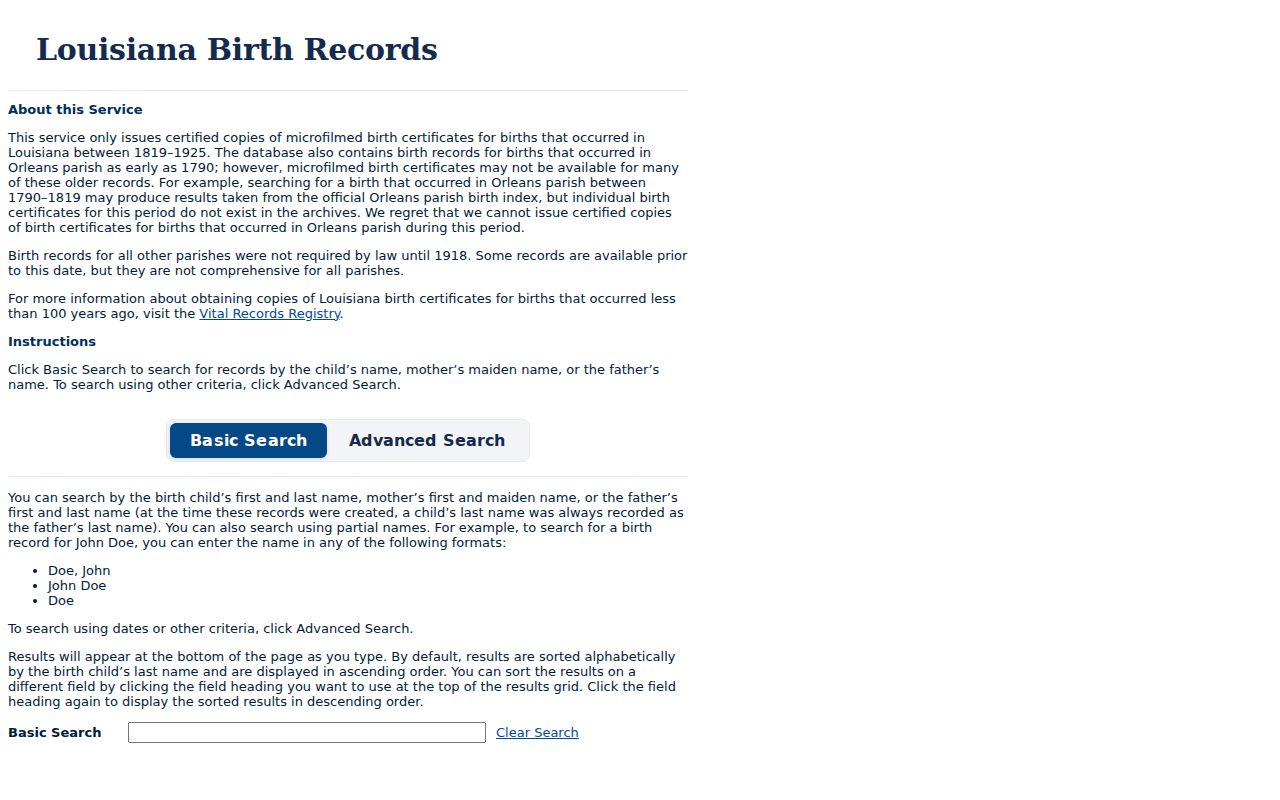
Use an index result as a pointer to the record and confirm access rules before ordering. Current vital records remain restricted, so newspapers, church registers, succession files, and Archives research can provide lawful historical alternatives.
Pair Chalmette Household Snapshots
Owners are only part of an address history. Telephone directories can tie a listed subscriber to a street in a publication year. A released federal census can show a household at a decennial snapshot. Newspapers, church files, and oral histories may explain family ties or a move. Each source has omissions, so combine them without stretching one record beyond its date.
- Locate the address in the closest available telephone or reverse directory and transcribe the entry exactly.
- Check the adjacent directory years for the first and last appearance of that name.
- Compare a legally released census near the directory date, using the household, street, neighbors, and place labels.
- Test surname variants in newspapers, church catalogs, vital indexes, succession records, and Nunez finding aids.
- Log contradictions. Keep an owner, subscriber, census household member, and oral-history subject as separate roles.
The historical volumes and their access routes are detailed on the Chalmette city directory page. No verified local cemetery database or complete obituary index was found, so use the State Library, State Archives, The St. Bernard Eagle lead, and Clerk probate records as fallbacks.
Lawful use. Research Chalmette previous residents for house history, genealogy, heirs, or personal curiosity. Never use old address clues to track, harass, or harm a living person.